
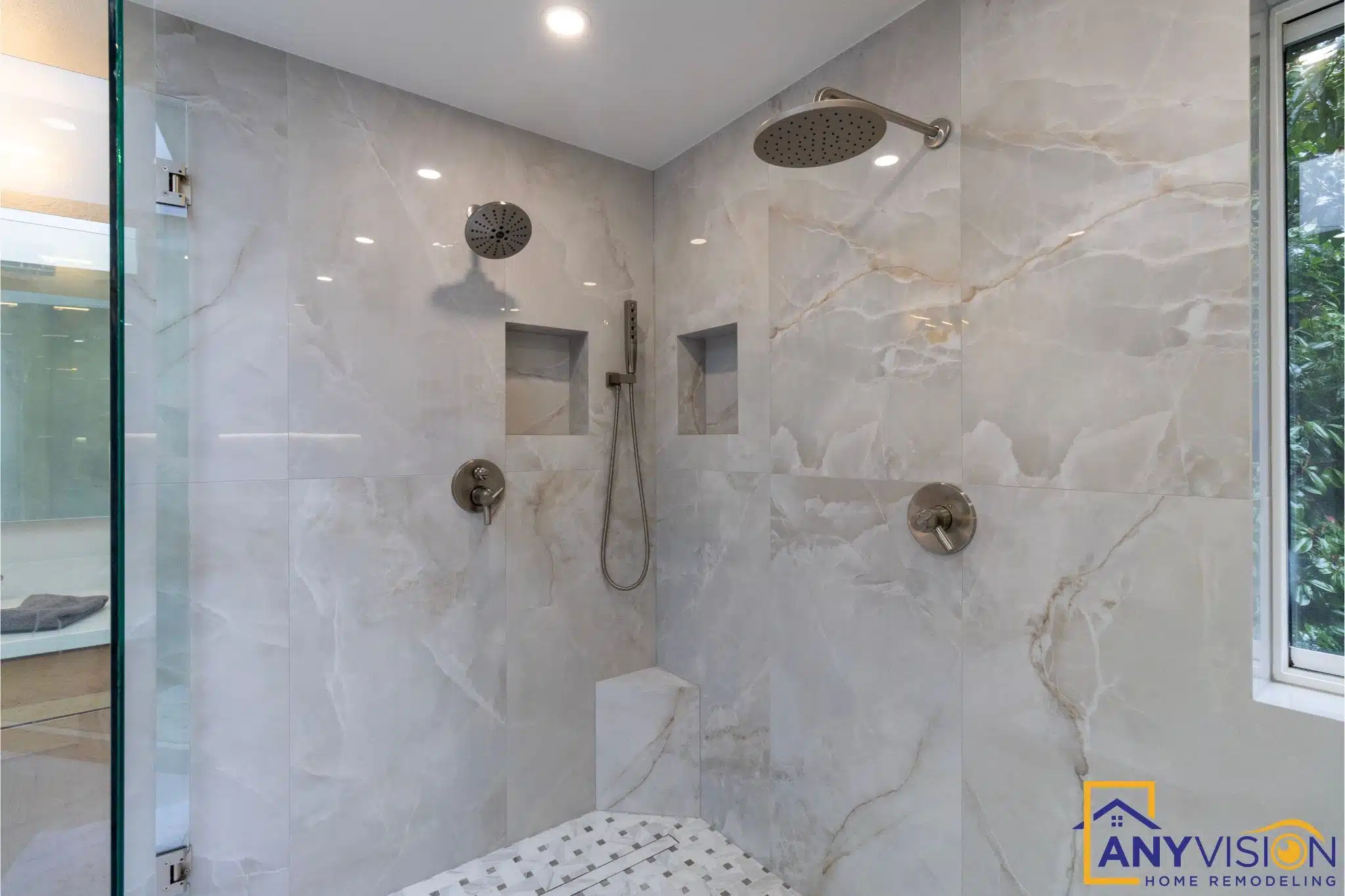
Why Seattle’s Weather Makes Waterproofing the First Bathroom Remodel Decision
Seattle’s Rainfall Directly Affects How Long Your Shower Assembly Lasts
In the Pacific Northwest, bathroom waterproofing determines the long-term performance of everything built around it.
Seattle’s climate creates a moisture load inside your home that most homeowners don’t think about until something fails. From October through April, ambient indoor humidity stays elevated for weeks at a time. Every hot shower adds moisture to an already-humid environment. A bathroom that gets heavy daily use in Redmond or Seattle isn’t drying out between uses the way it would in a drier climate. It stays damp. And that dampness has to go somewhere.
If your shower assembly gives it a path through the wall, it will take it.
How the PNW Wet Season Degrades Shower Assemblies Over Time
Seattle’s extended wet season puts shower walls under continuous moisture stress that most older assemblies weren’t designed to handle.
The issue isn’t a single flood event. It’s cumulative. Seven months of elevated humidity, combined with daily shower use, is a slow and invisible process.
Most homes built in the Seattle area before 2015 — and a significant portion of the 1990s and early 2000s housing stock in Sammamish, Kirkland, and Redmond — were built with standard mortar bed shower construction. A mortar bed is a thick layer of hand-mixed cement used as the base for tile floors and wall assemblies. It’s solid. But it’s porous.
Porous means it absorbs moisture. In a drier climate, absorbed moisture evaporates quickly. In a bathroom in Bellevue in November, it doesn’t. Moisture that enters a mortar bed assembly in fall can stay within the wall framing through spring. By that point, it’s been sitting against wood studs and OSB sheathing for months. The tile surface looks fine. You can’t see what’s happening behind it.
That’s the structural reality of wet climate shower tile failure in the Pacific Northwest. The damage accumulates silently, and the first visible sign — a cracked grout line, a soft floor tile near the drain, a faint smell with no obvious source — typically appears years after the moisture reached the substrate.
The issue is not a single flood event. It is cumulative — seven months of elevated humidity combined with daily use, slow and invisible.
The Full Picture: What Waterproofing Systems Actually Do
A waterproofing membrane keeps your wall assembly dry — and that’s the protection that matters.
That distinction matters. Let’s break it down.
Grout Joint Permeability: Why Grout Isn’t Waterproofing
Standard grout is not a waterproof material. It slows water. It does not stop it.
Water that sits on a tiled shower floor — or runs down a shower wall — eventually passes through grout joints. That’s grout joint permeability: the natural property of standard grout that allows water to migrate through it slowly over time. The rate depends on grout type, joint width, and how much daily use the shower gets.
In a properly built shower, this isn’t a problem. The waterproofing layer lives beneath the tile, not inside the grout joint. Water passes through the grout, hits the membrane, and runs to the drain. The wall framing never sees it.
In a shower without an effective membrane, that water passes through the grout and enters the mortar bed or cement board substrate. That’s when the clock starts.
Mortar Bed Shower Construction: Built for a Different Era
Mortar bed shower construction was the standard method for decades. It produces a firm, durable tile base. For much of the country, it performs well because the substrate has time to dry between wet cycles.
The Pacific Northwest wet season doesn’t provide that window. A mortar bed in a Seattle-area bathroom that gets daily use from October through April is wet more often than it’s dry. Moisture that enters in October may not fully evacuate until June — if the assembly is ventilated well and the shower is used lightly.
Most households don’t use their showers lightly.
Why Bonded Membrane Waterproofing Is the Seattle-Climate Standard
For a full breakdown of how Schluter-Kerdi integrates into a complete shower build — including substrate selection, drain compatibility, and tile-setting sequence — see the [Bathroom Remodeling service page](/services/bathroom-remodeling/). Here’s the core concept that explains why a bonded membrane is the right answer for Seattle-area climates specifically.
A bonded waterproofing membrane is a thin layer installed directly on the shower substrate before tile is set. It creates a continuous watertight surface. Moisture passes through the grout joint, hits the membrane, and goes to the drain. The substrate behind the membrane stays dry regardless of how long the shower runs or what month it is.
At Anyvision, we install a bonded membrane on every shower project as the default starting point — not an optional add-on. This approach was chosen specifically because it holds up through the sustained humidity that defines bathroom conditions across Redmond, Kirkland, Sammamish, and Seattle from fall through spring. A single failed week in a wet November is enough to start the moisture clock in an unprotected assembly.
Substrate Moisture Damage: What’s Actually at Risk
When waterproofing is absent or inadequate, moisture reaches the substrate. Substrate moisture damage is the physical deterioration of the materials behind your tile: cement board, OSB sheathing, wood framing. You can’t see this from the finished surface.
Over time, you’ll feel it. A tile that shifts under foot pressure. A hollow sound when you tap near the base of the wall. A floor section that yields slightly near the drain perimeter. By the time these signs appear, the substrate often needs full replacement before new tile can go in.
That’s a significantly larger project than a standard bathroom remodel.
Common Scenarios: What We Find During Seattle-Area Bathroom Tear-Outs
The three situations below show up regularly on Eastside and Seattle bathroom projects.
Scenario 1: The 2003 Sammamish Bathroom
A 2003 home in Sammamish. Tile looks fine from the outside — no visible cracks, consistent grout color. The homeowner wants an update: new tile, new fixtures, refreshed layout. Demo starts. Behind the original tile, the mortar bed is dark and saturated. The lower 18 inches of cement board on two walls show early deterioration. The framing is dry — caught before it went further. Full substrate replacement adds time and material cost to what started as a cosmetic update.
This is one of the most common discoveries on pre-2015 bathroom tear-outs in Sammamish and Redmond.
Scenario 2: The Recurring Grout Crack
A homeowner in Kirkland contacts us because the same grout joint at the base of the shower wall cracks every 8-12 months. They’ve had it regrouted twice. It keeps coming back. Recurring grout cracks at the same joint location are one of the early waterproofing failure signs worth paying attention to. Grout doesn’t crack from age alone. It cracks because the substrate behind it is moving — typically from moisture cycling. Regrouting treats the symptom. Membrane installation treats the cause.
Scenario 3: The Seattle DADU Bathroom
A detached accessory dwelling unit (DADU) in Seattle’s Rainier Valley. New construction, built to code, but the original builder used standard cement board and mastic adhesive in the shower — no bonded membrane. Two years of daily use in one of Seattle’s wetter zip codes and moisture is already tracking into the base of the wall assembly. Caught early — membrane installation and retile before the framing sees any damage.
Professional Perspective: What I See When We Open Seattle Bathroom Walls
I’ve been opening bathroom walls across Seattle, Redmond, and the Eastside since 2020. The pattern is consistent.
Pre-2015 bathrooms — especially in Sammamish and Kirkland where there’s a lot of late 1990s and early 2000s housing stock — were built with mortar beds or standard cement board and no waterproofing membrane. That wasn’t a mistake at the time. It was the standard method.
What wasn’t fully accounted for was the sustained humidity load a Pacific Northwest bathroom carries from October through April. Seven months where the bathroom never fully dries out. Seven months of daily showers stacking moisture into a porous assembly.
By the time we demo a bathroom like that, the mortar bed is saturated and the lower cement board is showing damage. The framing is usually okay — wood takes longer to show it. But the substrate is gone, and we’re rebuilding from scratch before the new tile can go in.
The homes where we don’t find this are the ones that already had a membrane — or the ones where the homeowner is calling us before the first visible crack appears.
That’s why we install a bonded waterproofing membrane on every single shower project. Not because every homeowner asks for it. Because in this climate, it’s the decision that determines whether the assembly lasts 5 years or 25.
When to Plan Your Shower Waterproofing Properly
You don’t need visible tile damage to have a waterproofing conversation worth having.
Start with a simple assessment. Tap the lower 12 inches of your shower wall tiles firmly with your knuckle. A solid sound means the tile is adhered properly. A hollow sound — even in one or two spots — means the tile has separated from the substrate beneath it. That separation can indicate moisture working behind the wall.
Next, look at your grout joints along the base of the shower floor and at the transition where the wall meets the floor pan. Grout that cracks in the same location repeatedly — not just once — is worth investigating.
A soft spot anywhere on the shower floor, especially near the drain perimeter, is a signal to act. So is a persistent musty smell in the bathroom without a visible source.
These are the early waterproofing failure signs that indicate moisture has already reached your substrate. The earlier you catch them, the smaller the repair scope.
If you’re planning a bathroom remodel, this is the right time to address waterproofing properly. A membrane installation added to an existing project costs a fraction of what it costs to do a second demo because the first remodel was built without one.
Contact Anyvision before the design phase starts. We review the existing assembly during the initial scoping conversation — before any work begins.
Where Shower Waterproofing Failures Show Up Most on the Eastside
Pre-2015 housing stock concentrated in specific Eastside neighborhoods is where we find the highest rate of substrate moisture damage.
Redmond’s Bear Creek and Education Hill neighborhoods carry a significant share of homes built between 1995 and 2010 — the era when mortar bed construction was standard and bonded membrane systems weren’t yet common practice. Kirkland’s Juanita and Bridle Trails areas show similar patterns. In Sammamish, the Klahanie and Trossachs developments from the late 1990s and early 2000s represent exactly the housing stock most likely to have original shower assemblies that have never been assessed for moisture intrusion.
Seattle zip codes 98118 (Rainier Valley) and 98103 (Fremont/Greenwood) add a different variable: DADU and ADU conversions where shower assemblies were installed to get the unit habitable quickly, sometimes without a bonded membrane. These are the bathrooms we open up and find early-stage moisture tracking at the wall base.
Each of these areas gets meaningful annual rainfall exposure and houses bathroom assemblies that were built before current membrane standards were widely adopted. That combination makes waterproofing assessment a standard part of how we scope any bathroom project in these neighborhoods.
Next Steps: Start With the Right Waterproofing Decision
The membrane goes in before tile — which means waterproofing is decided in the design phase, not after demolition.
If you’re researching a bathroom remodel in the Seattle area, the [Bathroom Remodeling service page](/services/bathroom-remodeling/) covers how Anyvision designs and builds shower assemblies from substrate to finished tile — including how membrane installation integrates with the full project scope.
Ready to talk about your project? Call 425-515-5796 or submit an estimate request at `/contact/`. Every inquiry gets a response within 24 hours.
--- JSON-LD Structured Data (for developer) ---
Building a Bathroom That Lasts
Plumbing rough-in is inspected in sequence before the walls close. It is the phase that decides how a bathroom looks in five years.